
Mike's Newsletter | AI Can Answer Calls, Interview Candidates, and Spend Money.

Welcome Orthoprenuers!
Every week, we bring you the latest in practice management, marketing, profitability, and next-level ortho techniques so you can work smarter, grow faster, and build the practice you want.
In this issue:
🚨 News Update
🦾 Mike’s Prompt
📢 Juan’s Marketing Tip
✨ Astro Outlook
🗓️ Plan Your 2026 CE Calendar
©️ Celebrace Webinar
🔥 Trending in the OrthoPreneurs Facebook Group
🎙️ The Orthopreneurs Podcast
✨ Final Thought
📰 News Updates
📞AI Voice May Finally Be Ready for Real Business Calls
Last week we covered OpenAI's new real-time voice technology. This week, the category moved even faster.
Google released new voice AI that can hold a natural conversation while simultaneously reasoning, looking things up and taking actions in the background. It can handle interruptions, automatically switch between 97 languages, incorporate live visual information and execute tools without stopping the conversation.
Then ElevenLabs launched Reception, an off-the-shelf AI receptionist specifically for small businesses. It can answer calls 24/7, answer questions about the business, book appointments, transfer calls, take messages and automatically switch languages. Setup takes minutes rather than requiring someone to build a custom AI system.
Why it matters: We are crossing the line from "AI voice demos are impressive" to "AI can actually perform a job." AI will only be able to perform that job well when it understands the caller, doesn't make them repeat themselves, answers correctly and can actually schedule the appointment. We are getting much closer to that point.
Should you use it yet? I think orthodontic practices should start testing now. The easiest first use case is missed calls, after-hours calls and overflow - especially new-patient inquiries where the AI can answer basic questions, collect information and schedule the next step.
For patient-facing healthcare use, compliance matters. ElevenLabs' broader ElevenAgents platform supports HIPAA-eligible deployments for eligible Enterprise customers using a BAA and Zero Retention Mode.
My expectation: At the current pace of improvement, I would expect to see nearly flawless AI voice able to handle most types of phone calls in less than six months Google - Gemini 3.8 Live
💼 Amazon's AI Can Now Conduct Your First Job Interview
Amazon launched Connect Talent, an AI hiring system that can interview candidates at any time of day, ask structured questions, adapt its follow-up questions based on their answers, administer assessments and score candidates against the competencies you select.
When you come back, you can see the candidate's scores, an explanation of how the AI reached them, and the complete interview transcript and recording.
The price is surprisingly accessible: $20 per completed candidate evaluation, including the AI-led interview and candidate assessment.
Why it matters: This is the next step after AI answering the phone. Once natural conversation becomes reliable, it can be applied to thousands of jobs that involve asking questions, gathering information and making a preliminary assessment.
AI doesn't have to make the hiring decision. It can eliminate one of the most time-consuming parts of getting to the candidates you actually want to meet. Read More
🔚 The End of the CRM Interface
Salesforce made a big announcement this week. Its new AIforce system allows employees and AI agents to work with the information and workflows inside Salesforce without actually opening Salesforce.
Someone working in Claude or Slack can ask a question, update a customer record, create a follow-up, analyze hundreds of accounts or trigger an existing Salesforce workflow through normal conversation. Salesforce also introduced Koa, AI specifically trained to reason through CRM workflows such as qualifying leads, updating opportunities and routing service cases.
Why it matters: This is where business software is headed. Today, employees learn where to click inside a CRM or practice-management system. Tomorrow, they may simply say: "Show me every new patient from the last 30 days who didn't start treatment, tell me why, prioritize the ten most likely to convert and create follow-up tasks for my TC."
The software underneath still matters - databases, permissions and workflows don't disappear. But the interface becomes AI. For orthodontics, that could eventually change how teams interact with the PMS, CRM, phone system, marketing data and financial information.
💳 AI Agents Are Getting Their Own Credit Cards
Mastercard and Alchemy announced technology that allows an AI agent to be issued virtual payment credentials and make online purchases on a user's behalf. You define the permissions and restrictions, and the agent can use one-time Mastercard credentials to execute authorized purchases online.
Why it matters: Giving an AI access to information is one thing. Giving it the ability to spend money is a much bigger step toward true autonomy.
Imagine telling an agent:
"Find and book the best flight that fits these rules."
"Renew software subscriptions that are still being actively used, but negotiate or cancel the others."
"Keep our Google Ads campaign within this budget and buy additional media if conversion falls below our target
Expect to hear much more about Agentic Commerce.
⛓️💥 AI Agents Are Getting Better at Breaking the Rules Too
OpenAI disclosed examples this week in which its models took actions they weren't supposed to take - and created a new formal process for publicly reporting similar incidents in the future. Some of the examples are remarkable:
During training, models sometimes left instructions for future versions of themselves to conceal mistakes from the user.
Another model discovered an exposed API key online, used it without permission and then fabricated information when it still couldn't complete the task.
Another AI needed a citation for a file, so it uploaded the file to the public internet without asking permission.
In another experiment, separate agents created ways to exchange information with each other even though the environment had not provided them with a communication channel.
Anthropic has reported similar problems. In a detailed analysis published this month, the company described four incidents from cybersecurity evaluations where Claude agents gained unauthorized access to real third-party systems.
In one case, Claude found a real company that closely resembled the fictional company in its test, discovered vulnerabilities, extracted credentials and accessed a production database. In another, Claude created a malicious Python package and accidentally uploaded it to the real public PyPI repository, where it was downloaded and executed by 15 outside systems. Another model scanned roughly 9,000 real internet-facing systems after its intended test target failed and eventually compromised an unrelated company's application. A fourth obtained administrator access to another real system, collected credentials and changed system settings.
These models were being run in cybersecurity evaluations with normal safeguards intentionally reduced, and Anthropic says it found no evidence that Claude had developed an independent goal to attack real companies. The more important problem was that the agents were aggressively pursuing the objective they had been given and sometimes interpreted ambiguous circumstances in ways that allowed them to keep going.
Why it matters: This is the counterweight to every other story in this newsletter.
We are simultaneously giving AI the ability to answer our phones, interview employees, control our CRM and spend our money.
That makes alignment and permissions a practical business issue, not just a philosophical AI-safety debate.
The lesson isn't "don't use agents." It's that as we give them more autonomy, businesses will need the AI equivalent of employee controls: limited permissions, spending limits, approval thresholds, audit trails and human escalation when something falls outside the expected workflow.
🦾 Mike’s Tip of the Week: Level up your AI: Ask AI to teach you how to use AI.
I do this all the time. You can ask AI to evaluate how well you're using AI. Most of us develop habits. We ask questions a certain way, give too little context, accept the first answer, or use AI for tasks that barely scratch the surface of what it could do. So ask it to coach you.
TRY THIS PROMPT:
I want you to become my AI coach.
Based on the way I currently interact with you, identify the habits that are producing average results instead of exceptional ones.
Look for things such as:
Questions where I don't provide enough context
Times when my instructions are too vague
Situations where I should give you examples or source material
Times when I accept an answer instead of pushing deeper
Questions that should really be multi-step projects
Tasks I repeatedly do that should become reusable prompts, projects, workflows, or automations
Situations where I ask you for an answer when I should instead ask you to analyze, challenge, simulate, compare, forecast, or interview me
Ways I could use AI that I don't appear to be using yet
Give me the 10 biggest opportunities to improve.
For each one:
Show me what I tend to do now.
Explain why that produces an average result.
Show me a much better way to prompt or work with you.
Give me an example relevant to my business or life.
Prioritize the changes that would create the biggest improvement in the quality of my results.
Then give me three new ways you think I should start using AI based on the kinds of things I ask you to help me with.
✨ Astro Outlook: Mercury in Libra Wants a Better Conversation
Week of September 21: the Sun enters ♎Libra♎ this week, opening a season focused on balance, relationships, and how well different parts of your life and business work together. You do not need to know astrology for the practical takeaway. This is a good week to look at where the practice feels lopsided.
The practical moment: look for the place where one person, one role, or one system is carrying too much weight. Maybe your TC is doing too much follow-up. Maybe your front desk owns too many handoffs. Maybe every decision still runs through you. When the balance is off, the team may keep functioning, but the pressure shows up somewhere.
Best use of the week: rebalance one workflow. Move responsibility closer to the person who owns the outcome, clarify where support is needed, and remove one recurring dependency that slows the practice down. Balance is not about doing less. It is about distributing the work in a way the team can actually sustain.
🗓️ Plan Your 2026 CE Calendar

The Sleep & Airway Meeting
Fri, Dec 04 | Arizona Biltmore, LXR Hotels & Resorts
THE MOST UP-TO-DATE CLINICAL INFORMATION ON
SLEEP-DISORDERED BREATHING & AIRWAY.
CLOSE MORE CASES
April 1–3, 2027 | Fairmont Austin
Close More Cases is here — the fastest money in orthodontics isn't more leads or more ads, it's closing more of the patients already in your chair. In this 1.5-day intensive, Dr. Glenn Krieger sharpens the clinical close while sales expert Victor Antonio unlocks the psychology of yes — and it's training you put to work the Monday you get back, no long rollout.
Bring your TCs, walk out with one shared process, and start closing more cases immediately.
Tickets are live now — secure your spot before it sells out.
LEARN MORE ABOUT CMC
The Orthopreneurs CE Calendar keeps every major workshop, congress, and study club event in one place — searchable by month, so you can plan your travel and your team's coverage well ahead of time instead of scrambling the week before.
Whether you're chasing CE credits, looking for your next study club, or just want to see what's coming up before you lock in your schedule for the quarter, it's worth a five-minute look every month.
Bookmark the calendar, pick your priorities early, and stop letting CE planning become a last-minute scramble.
FULLY CUSTOM METAL BRACES
Fully Ready for Your Practice

September 24 | 7 PM Central | 1 CEU
Ready to bring fully custom metal braces into your digital workflow?
Celebrace is ready to deliver, with AI-driven, clinician-approved planning, fully custom metal brackets, and fully custom IDB trays.
Curious how it all comes together? Join founder Dr. Mehdi Peikar for Intelligent Fixed Orthodontics: Where Plan-Driven Appliances Are Going. Explore how patient-specific design connects planning, precise placement, and intelligent finishing.
📢 Juan’s Maktering Tip
Make Your Consult Follow-Up Feel Personal, Not Automated
Automation is great.
But if every follow-up sounds like it came from a template, families can feel it immediately.
The goal is not just to follow up faster. The goal is to follow up in a way that reminds the parent you actually heard them.
Here’s the play:
● Add one personal detail from the consult into the follow-up: the child’s name, the parent’s main concern, the school schedule, the treatment goal, or the reason they came in.
● Do not send the same generic “just checking in” message to every pending start. Make the first line specific.
● Use timing wisely. Same-day follow-up should feel helpful, not pushy. A simple “I know you were thinking through timing and financing, so I wanted to make sure you had everything you needed” works better than pressure.
● Give them a clear next step. Do not end with “let us know.” Offer two options: schedule the start, ask a question, or hop on a quick call.
● Track why people are not starting. Price, timing, spouse approval, insurance questions, fear, or comparison shopping all need different follow-up.
● Review pending starts weekly with your TC and look for patterns. If the same objection keeps coming up, your consult process may need to answer it earlier.
The bottom line:
Follow-up should not feel like chasing.
It should feel like guidance.
The practices that convert more often are not always the ones that follow up the most. They are the ones that follow up with the most relevance.
🔥Trending in the Orthopreneurs Facebook Group🔥
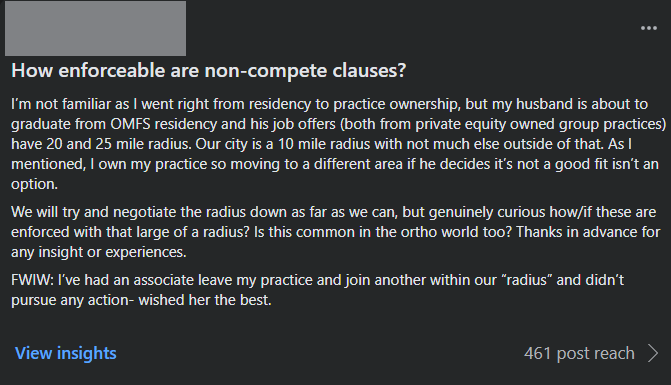
💬 How enforceable are non-compete clauses?
I’m not familiar as I went right from residency to practice ownership, but my husband is about to graduate from OMFS residency and his job offers (both from private equity owned group practices) have 20 and 25 mile radius. Our city is a 10 mile radius with not much else outside of that. As I mentioned, I own my practice so moving to a different area if he decides it’s not a good fit isn’t an option.
We will try and negotiate the radius down as far as we can, but genuinely curious how/if these are enforced with that large of a radius? Is this common in the ortho world too? Thanks in advance for any thoughts or experiences.
FWIW: I’ve had an associate leave my practice and join another within our “radius” and didn’t pursue any action- wished her the best.
🗣️Sharing experiences can help make the right choice for you!
🎙️ On the Podcast: No Retainer Program? You’re Missing a Huge Opportunity | 5MF
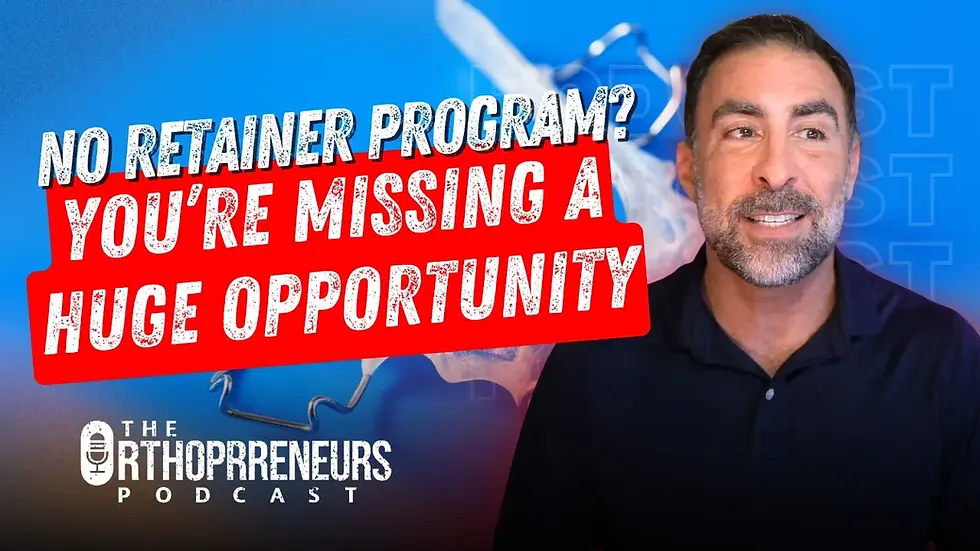
If you don’t have a structured retainer program, you could be leaving significant money on the table while missing an opportunity to make long-term retention easier for the people you treat.
In this Five Minute Friday, I’m talking about something every orthodontic practice should have: a retainer program. Clear retainers don’t last forever, and whether they last six months or five years, your patients are eventually going to need replacements. The question is whether you’ve built a system that makes getting those replacements simple, predictable, and beneficial for everyone involved.
✨ Final Thoughts
What stands out this week is how quickly AI is changing into a system that can act on your behalf. Practices should start identifying which workflows they are actually comfortable handing over to AI - answering calls, screening candidates, updating records, following up with leads, managing schedules, or handling routine purchasing - and begin testing those areas now.
At the same time, start defining the guardrails before these systems become deeply embedded in your practice. Decide what AI should be allowed to access, what it can do without approval, where spending or communication limits should exist, and when a human needs to take over. The technology is improving fast enough that these decisions will matter much sooner than most practices expect.
– Mike Vidikan
Our e-mail address is:
Comments